


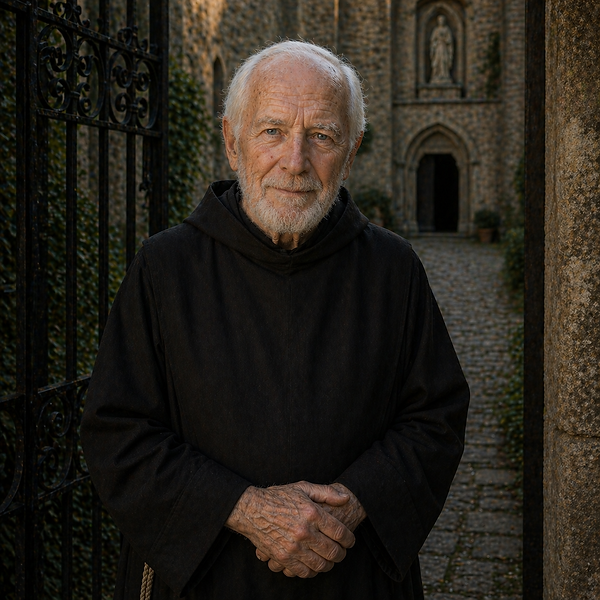
Father Stephen Makris
Stephen was born in Thessaloniki, Greece, which rests on the northern shore of the Aegean Sea. Thessaloniki boasted biblical roots as one of three cities the Apostle Paul visited on his second missionary journey in 50 AD. Paul wrote two canonical epistles to the believers there, 1st and 2nd Thessalonians. He was named after the first Christian martyr, Stephen, who was stoned by the Jewish elders for blasphemy, as told in the book of Acts. Stephen’s parents were Nico and Selene Makris. He was the third of five children.
On the day Stephen was born, a large comet streaked across the skies of Eastern Greece. Subsequent reports of the event were confusing. According to the Hellenic National Meteorological Service, no such event was forecast. While the comet was judged to be 50 to 60 miles wide, 8 times the size of a normal asteroid, meteorologists failed to foresee the event. Nor could they explain how quickly it disappeared. It was visible for perhaps thirty minutes, then simply vanished.
Stephen was a precocious child. He began reading at age two. Within three years, he was capable of Complex Musical Memorization. He could play intricate, multi-layered piano compositions after hearing them just once. He was deemed a savant. At age 9, he was perfecting Visuo-Spatial Mapping, capable of drawing complex, true-to-life cityscapes from memory after only a brief aerial viewing. His parents were proud of his achievements. But even they were mystified by his abilities.
Stephen was a sweet and congenial child, totally unfazed by his ability to converse just as easily with learned scholars as with children his own age. Through the efforts of the Greek Orthodox Church, he was allowed to enter an accelerated educational program. He graduated from high school at age 15. Two years later, he finished college and was admitted to the Kapodistrian University of Athens to study theology. It was there that he found a home. The Bible held all the secrets of the universe, and he was intent on exploring them. Following graduation, he sought ordination as a Greek Orthodox Priest. He was first ordained into the Holy Orders as a Diaconate or deacon. He spent six months at this level, then decided his path should be more austere. With the aid of his bishopric or diocese, he applied to, and was accepted as a novitiate at the monastery of Saint Markos in southern Israel.
His reputation preceded him. His superior intellect and achievements were well-known among his fellow monks, but it was his resolute commitment to the monastic ways that separated him from his fellow novices. As was custom, each day he observed the Great Silence, a strict period of silence observed from the evening meal until the following morning’s prayer. Meals were eaten in total silence to allow for personal reflection, but the daytime was spent on common work. Stephen was assigned kitchen duty, in which he prepared and served meals to his fellow monks. Conversing was allowed, but idle conversation was discouraged. Three times per week, they enjoyed “Recreational Time” in which they were allowed to converse freely, socialize, and bond. Prayer and meditation were foremost on everyone’s agenda.
At age 30, Stephen was granted leave by the abbot of Saint Markos. An unusual request for any monk, but especially for Stephen, as he was on a trajectory to achieve great things within the monastery hierarchy. He first traveled to northern Africa, where he spent two years in Alexandria, studying the writings of St. Mark, who first brought Christianity to the Dark Continent in the first century. While there, he successfully transcribed the mystifying Katadesmoi Stone, an ancient Greek tablet also known as the Curse Tablets, written in the 6th century BCE. His translation addressed many unanswered questions about this ancient stone. He lived for two years in Annaba in northeastern Algeria, historically known as Hippo Regius, studying the writings of its most famous theologian, St. Augustine of Hippo. Stephen revered Augustine above all saints, as he wrote the first and most complete treatise on the foundations of the Orthodox church with his book “The City of God.” Stephen had memorized lengthy passages from this seminal book, offering his own interpretation of its nuanced pronouncements on the Christian life. It was while in Annaba that he wrote the book Michael Shaw refers to: “Ancient Icons in a Modern World.”
From there, he traveled to western Europe, an area largely secular, with few people affiliating with any church. Roman Catholicism was found in Spain, Italy, and France, while Protestantism held sway in the United Kingdom, Germany, and the Nordic countries. Stephen spent five years traveling to both large cities and quaint villages, all the while reading, teaching, and learning from their populace. He wrote several lengthy books during this time, many of which were meditative studies on ancient Christian themes, two of which became bestsellers. Not only was he a revered presence in the theological world, but he was also now a published author.
After ten years of travel, Stephen returned to Saint Markos. He was welcomed with open arms. Once again, he applied himself to his monastic duties, rising quickly through the hierarchy of positions within the monastery: Rassaphore, Stavrophore, Schema-Hegumen, and finally O Agios, the Holy One. Only eleven men had achieved this title over the past six centuries. It was at this point that Stephen chose to become an Eremit, a solitary hermit living in a cave near the monastery. Only once did he leave his cave during that time, and that was to visit a dying priest, Father Nikolai Pappas, whom he saved through the miracle of healing.
And it was early on a Sunday morning when he had the vision of two solitary travelers, waking shoulder to shoulder on a steep path that led uphill. It had been a dangerous and difficult journey. Their destination: Saint Markos. Their mission was one from God. Stephen packed up his meager belongings and returned to the monastery.
He would be there when the Chosen Ones arrived.